
Are Retro Games Actually Harder or Have We Just Gotten Soft?
Examining whether classic games were genuinely more challenging or if modern gaming conventions have conditioned us for easier experiences.
The Difficulty Debate
Ask any gamer who grew up in the 8-bit or 16-bit era, and they'll likely tell you: "Games were harder back then." But is this actually true, or is it selective memory combined with modern gaming's evolution? Let's examine the evidence.
Objective Difficulty Factors
1. Lives and Continues
Retro Reality
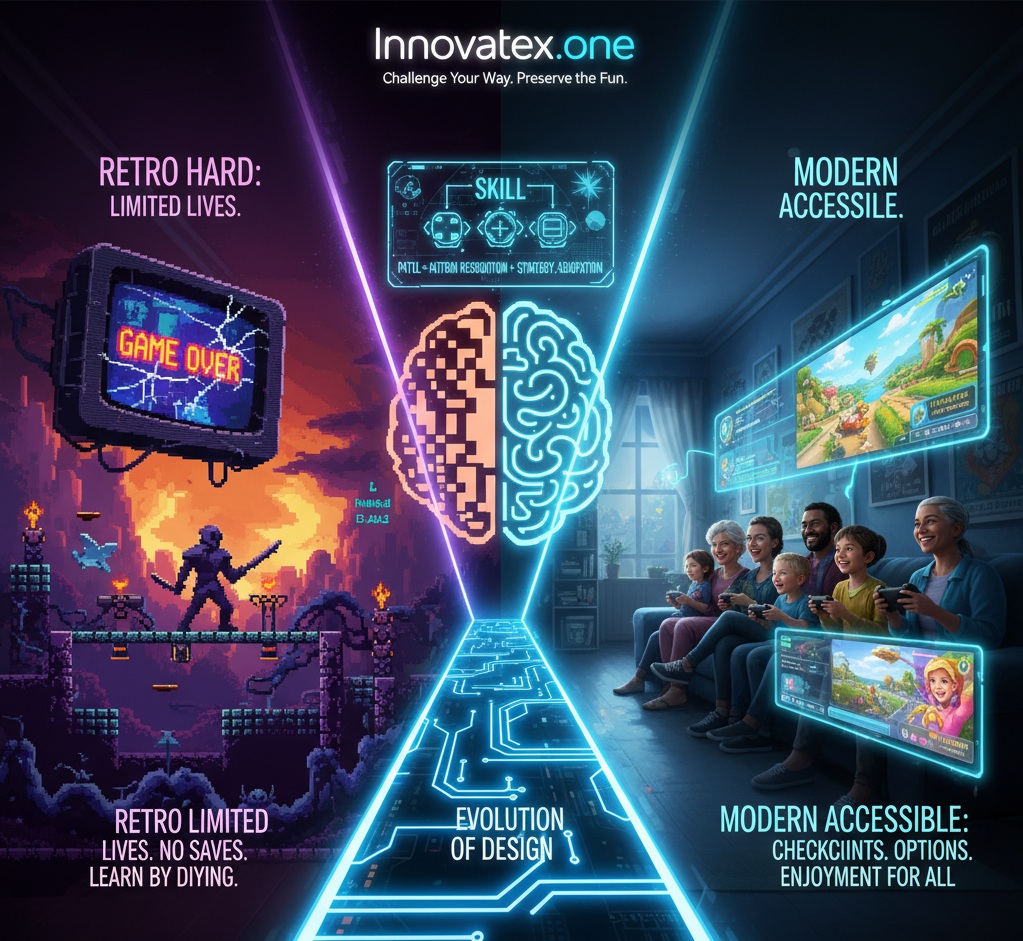
Most classic games gave you 3-5 lives and limited continues. Die too many times? Start from the beginning. This wasn't design philosophy—it was arcade economics. Games needed to eat quarters.
Modern Reality
Unlimited lives, generous checkpoints, and auto-saves mean death is a minor inconvenience, not a complete restart. You're never more than a few minutes from where you died.
Verdict: Retro games were objectively harder in this respect. Consequences for failure were severe.
2. Save Systems
Retro Reality
Many games offered no saves at all. Beat the entire game in one sitting or leave your console on overnight. Password systems helped but were tedious and prone to transcription errors.
Later games added battery saves but limited save points to specific locations, often far apart.
Modern Reality
Auto-save everywhere. Quick-save whenever you want. Multiple save slots. Cloud saves preventing loss. Death means reloading 30 seconds ago, not losing hours of progress.
Verdict: The lack of convenient saves made retro games significantly more demanding.
3. Tutorial and Guidance
Retro Reality
Minimal or no tutorials. Games expected you to figure out mechanics through experimentation. Manuals provided some guidance, but in-game teaching was learning by dying.
Modern Reality
Extensive tutorials, tooltip pop-ups, and waypoint markers. Modern games explicitly teach every mechanic and often won't let you progress until you've demonstrated mastery of the current concept.
Verdict: Retro games required more player initiative and experimentation.
4. Information Availability
Retro Reality
Stuck? Your options were:
- Trial and error
- Ask friends
- Buy strategy guides ($15-$30)
- Call tip hotlines (expensive)
- Wait for magazine walkthroughs
Modern Reality
Stuck? Google it. Video walkthroughs, wiki guides, Reddit threads, and Discord communities provide instant help for any problem.
Verdict: While not making games mechanically harder, lack of instant information increased effective difficulty.
Subjective Difficulty Factors
1. "Nintendo Hard" Philosophy
Design Philosophy
Many retro games, especially from Japanese developers, embraced punishing difficulty as a virtue. Ghosts 'n Goblins, Ninja Gaiden, and Battletoads became legendary for difficulty bordering on unfair.
This wasn't always intentional good design. Sometimes it was:
- Artificial lengthening (short games made artificially longer through extreme difficulty)
- Trial-and-error design (memorize patterns or die)
- Arcade quarter-eating tactics carried to home consoles
Was This Good?
Debatable. High difficulty created memorable challenges and bragging rights. But frustration that causes players to quit isn't good design—it's poorly balanced challenge.
2. The Learning Curve
Player Experience
When retro games were new, we were learning gaming literacy from scratch. Every genre was new. Every control scheme was unfamiliar. Naturally, everything felt harder.
Now, gamers have decades of accumulated literacy:
- WASD movement is intuitive
- Platforming physics are familiar
- Game design tropes are recognized instantly
- Pattern recognition is well-developed
The Experiment
Watch a 10-year-old play a NES game for the first time. They'll struggle, not because the game is hard, but because the conventions are unfamiliar. Meanwhile, they breeze through modern games using established literacy.
Verdict: Some "difficulty" was actually unfamiliarity, which experience has eliminated.
3. Technical Limitations Masquerading as Difficulty
Hardware Constraints
Many retro challenges stemmed from technical limitations:
- Imprecise Controls: Limited controller inputs and lower polling rates made precise control harder
- Screen Limits: Can't see approaching dangers off-screen
- Sprite Flicker: Too many objects caused sprites to disappear
- Slowdown: Too much action caused frame rate drops
- Hit Detection: Imprecise collision detection made success feel random
Were These Challenges Fair?
No. These weren't skill tests—they were hardware limitations creating artificial difficulty. Modern games eliminate these issues, making them "easier" but more fair.
4. Time Investment vs. Skill
Retro Pattern
Many retro games required memorization more than skill:
- Memorize enemy spawn points
- Learn pattern sequences
- Remember trap locations
- Perfect pixel-perfect jumps through repetition
Modern Pattern
Contemporary games emphasize different skills:
- Strategic thinking
- Resource management
- Moral choices
- Exploration
- Puzzle-solving
Different, Not Easier
Modern games shifted from memorization-based difficulty to other challenge types. A game like Portal or The Witness demands different skills than Contra, but isn't necessarily easier.
Fair vs. Unfair Difficulty
What Made Retro Games Feel Unfair
Blind Jumps
Leaps of faith with no way to see what's below. Success required memorizing level layouts through death.
Instant Death Obstacles
One-hit-kill spikes, pits, and enemies that punish exploration and experimentation.
Checkpoints Before Boss Fights
Running through the same level section repeatedly just to reach the boss you're learning to beat.
Enemy Spawns
Enemies spawning from off-screen with no warning, creating unavoidable damage.
RNG Unfairness
Random elements that could make sections trivial or impossible based on luck.
What Modern Games Do Better
Telegraph Danger
Modern games signal threats before they become problems. Visual cues, audio warnings, and environmental hints prepare players.
Consistent Rules
Modern games establish clear rules and rarely violate them. Retro games often had unexplained exceptions.
Graduated Difficulty
Modern games introduce concepts gradually, testing understanding before increasing complexity. Retro games sometimes threw everything at once.
Accessible Difficulty Options
Many modern games offer difficulty settings, assist modes, and accessibility options. Everyone can enjoy the experience at their comfort level.
The Conditioning Effect
We've Been Trained
Decades of gaming have conditioned expectations:
Modern Conditioning
- Save anywhere is expected
- Autosaving is assumed
- Health regeneration is common
- Infinite continues are default
- Generous checkpoints are standard
Returning to Retro
When these conveniences disappear, games feel dramatically harder. But is this harder, or just different from what we've been conditioned to expect?
Adaptive Difficulty
Many modern games implement adaptive difficulty:
- Dynamic difficulty adjustment (DDA)
- Rubber-banding in racing games
- Enemy scaling
- Hidden assistance systems
We might be playing "harder" than we realize, with games secretly adjusting to keep us in the flow state.
Different, Not Just Harder
Retro Priorities
Classic games prioritized:
- Mechanical skill (reflexes, timing, precision)
- Memorization (layouts, patterns, spawns)
- Resource management (limited lives, no saves)
- Repetition tolerance (replaying content)
Modern Priorities
Contemporary games prioritize:
- Strategic thinking
- Exploration freedom
- Player expression
- Narrative engagement
- Accessibility
Neither Is "Better"
These are different design philosophies serving different goals. Retro games created intense challenges requiring mastery. Modern games create expansive experiences serving diverse playstyles.
The Speedrunning Perspective
Watch speedrunners tackle retro games. They make "impossible" games look trivial through:
- Perfect pattern execution
- Frame-perfect inputs
- Exploitation of game physics
- RNG manipulation
This demonstrates that retro difficulty came from learning curves, not insurmountable challenge. With knowledge and practice, these games become manageable—even broken.
Modern speedrunning shows contemporary games have similar depth. The challenges look different but require comparable skill to master.
So What's the Answer?
Were Retro Games Harder?
Yes, in these ways:
- Harsh consequences for failure (limited lives/continues)
- Infrequent or absent save systems
- Less hand-holding and guidance
- Trial-and-error design requiring memorization
No, in these ways:
- Shorter overall length (most beat in 30-60 minutes)
- Simpler mechanics (fewer systems to master)
- Pattern-based design (memorize, then execute)
- Technical limitations creating artificial difficulty
Have We Gotten Soft?
Maybe, but that's not bad:
- We expect fair challenge, not artificial frustration
- We value time and want reasonable checkpoints
- We appreciate accessible difficulty options
- We recognize the difference between hard and unfair
Skills have shifted:
- Less memorization of specific solutions
- More strategic thinking and planning
- Different genre mastery (3D navigation, complex RPG systems)
- Multitasking across more complex mechanics
The Real Difference: Design Philosophy
Retro games came from an era when:
- Arcade quarter-eating influenced design
- Game length was limited by cartridge size
- Difficulty extended playtime artificially
- "Nintendo hard" was a badge of honor
Modern games exist in an era when:
- Players have infinite entertainment options
- Frustration sends players to competitors
- Accessibility is valued
- Diverse audiences demand variety
Neither approach is wrong—they serve different audiences and goals.
Appreciating Both
What Retro Difficulty Teaches
- Perseverance through challenge
- Satisfaction of earned victory
- Mastery through repetition
- Pattern recognition skills
What Modern Design Offers
- Accessibility for diverse skill levels
- Fair challenge without frustration
- Respect for player time
- Multiple difficulty philosophies
The Balanced Perspective
Retro games were harder in specific, measurable ways. But "harder" doesn't mean "better." It means different design priorities serving different goals.
Modern gamers aren't soft—they simply recognize that frustrating ≠ challenging, and artificial difficulty ≠ good design.
The best games—retro or modern—provide fair challenges that test skill, teach through gameplay, and respect player investment. Whether that means limited lives or generous checkpoints is less important than whether the challenge feels meaningful.
Conclusion
Retro games were objectively harder in many ways: limited lives, sparse checkpoints, minimal guidance, and design influenced by arcade economics. But they were also shorter, simpler, and pattern-based.
Modern games traded memorization-based difficulty for strategic depth, accessibility options, and respect for player time. Different doesn't mean easier—just different priorities.
We haven't gotten soft. We've gotten experienced. We recognize fair challenge from artificial frustration. And we appreciate that gaming is big enough for both hardcore challenges and accessible experiences.
Whether you prefer retro difficulty or modern accessibility, Innovatex.one offers the chance to experience classic challenges on your terms—with save states, rewind, and the freedom to engage with gaming history however you choose.
About the Author
Sarah Mitchell is part of the Innovatex team, dedicated to preserving and sharing the rich history of retro gaming with enthusiasts worldwide.
Related Articles
Why Retro Games Still Feel More Engaging Than Modern Titles
Explore the design principles and psychological factors that make classic games remain captivating decades after their release, often surpassing modern counterparts.