
Why Retro Games Still Feel More Engaging Than Modern Titles
Explore the design principles and psychological factors that make classic games remain captivating decades after their release, often surpassing modern counterparts.
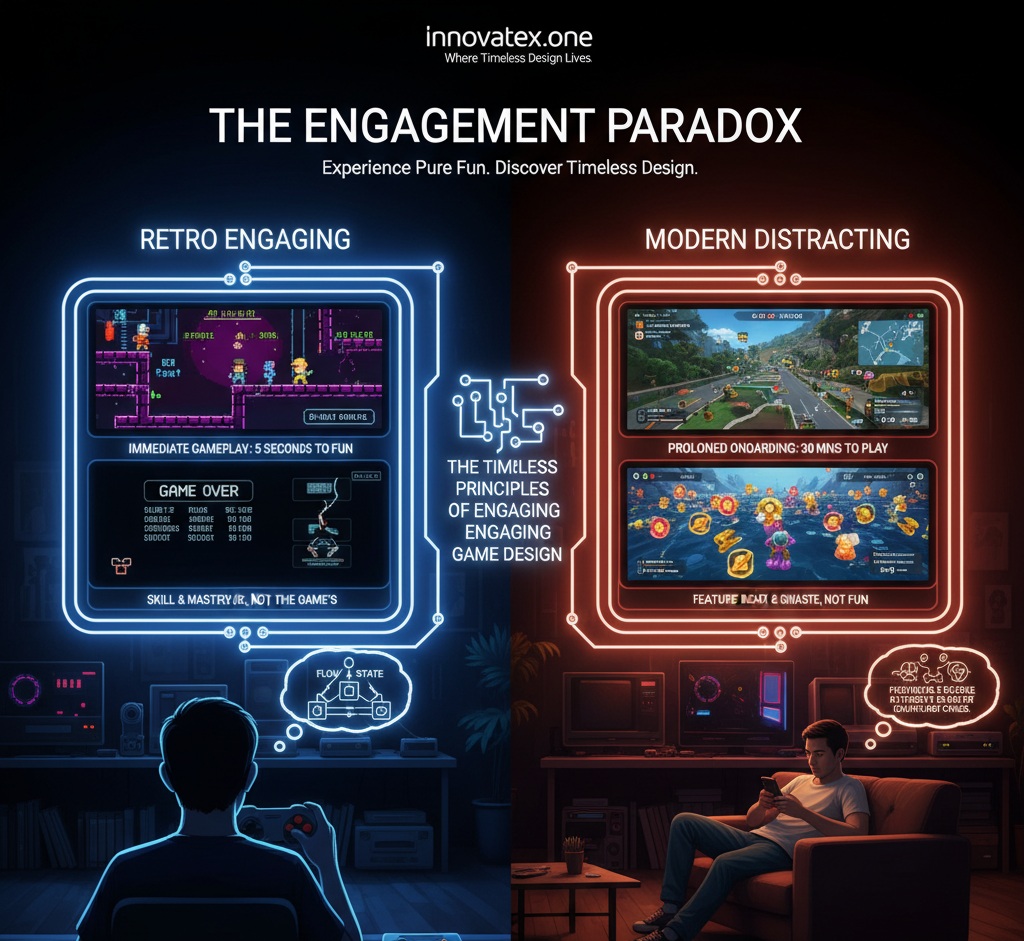
The Engagement Paradox
Modern games offer photorealistic graphics, orchestral soundtracks, Hollywood voice acting, and budgets that dwarf most films. Yet many players find themselves returning to decades-old games with 8-bit graphics and beep-boop sound effects. Why?
The answer lies not in nostalgia (though that plays a role) but in fundamental design principles that modern gaming has often abandoned in pursuit of other goals.
1. Immediate Gameplay Loop
Retro Games: Instant Action
Boot up Super Mario Bros. Press start. You're playing within 5 seconds. The first level teaches you everything you need to know through gameplay, not cutscenes or tutorials.
Design Principle: Respect player time by frontloading fun.
Modern Games: Prolonged Onboarding
Many contemporary games require:
- Lengthy introductions
- Unskippable cutscenes
- Extended tutorials
- Slow-paced opening sequences
By the time you reach "real" gameplay, 30-60 minutes have passed. First impressions matter, and retro games understand this instinctively.
Why This Matters
Human attention spans haven't grown. If anything, they've shrunk. Games that make you wait to have fun are fighting an uphill battle against every other entertainment option competing for your time.
Retro games respect that your time is valuable. They deliver dopamine hits immediately and maintain engagement through constant activity rather than delayed gratification.
2. Perfect Difficulty Balance
The "Easy to Learn, Hard to Master" Philosophy
Retro games excel at creating difficulty curves that:
Start Accessible
Anyone can play the first level of Pac-Man or Tetris. Success feels achievable immediately.
Gradually Increase Complexity
Each level introduces slightly more challenge. You grow with the game.
Reward Mastery
Getting good feels meaningful. High scores, speedruns, and perfect clears become personal achievements.
Never Feel Unfair
When you fail, it's your fault. Games telegraph danger. Pattern recognition and skill development matter more than reflexes alone.
Modern Difficulty Issues
Contemporary games often struggle with difficulty:
Too Easy
Aggressive auto-aim, regenerating health, and generous checkpoints reduce challenge to near zero. Success feels hollow.
Too Hard
Dark Souls-inspired difficulty without the careful balancing creates frustration rather than satisfaction.
Inconsistent
Difficulty spikes occur arbitrarily. Easy sections suddenly become impossibly hard without clear progression.
The Flow State
Psychologist Mihály Csíkszentmihályi identified "flow"—the mental state of complete engagement—requires challenges matching skill level. Retro games naturally create flow:
- Clear goals (reach the end, get high score)
- Immediate feedback (did I jump right? immediate consequence)
- Challenge matching ability (early levels easy, later levels hard)
Modern games often break flow with cutscenes, tutorials, and inconsistent pacing.
3. Pure Gameplay Focus
Retro Games: Mechanics First
Limited hardware forced designers to focus on what mattered: gameplay mechanics. Every element serves game feel.
Super Mario Bros: Jump physics feel perfect. That's all that matters. Everything else—graphics, sound, story—supports this core mechanic.
Tetris: Pieces fall. You rotate and place them. This simple mechanic creates infinite engagement through mastery and strategy.
Modern Games: Feature Bloat
Contemporary games often add features without asking if they improve gameplay:
- Crafting systems nobody asked for
- RPG mechanics tacked onto action games
- Open worlds that pad runtime without adding fun
- Collectibles that incentivize tedium over enjoyment
More isn't always better. Retro games prove that tight, focused design beats feature checklists.
4. Respect for Player Intelligence
Show, Don't Tell
Mega Man teaches its gameplay without tutorials:
- See an enemy. It moves predictably
- Try shooting it. It dies
- Get hit. You take damage
- See spikes. They look dangerous. They are
Within 60 seconds, you understand the game through experience, not explanation.
Modern Hand-Holding
Many current games assume players can't figure anything out:
- Tutorial pop-ups for obvious mechanics
- Waypoint markers removing exploration
- Quest logs telling you exactly what to do
- NPCs repeating hints ad nauseam
This isn't more accessible—it's insulting. Players aren't stupid. Trust them to learn through play.
5. Meaningful Player Agency
Every Action Matters
In Pac-Man, each decision—which direction to turn, when to grab a power pellet—carries weight. There's no auto-pilot mode.
In fighting games like Street Fighter II, spacing, timing, and move selection create a mental chess game where every input matters.
Autopilot Modern Gaming
Many contemporary games play themselves:
- Auto-aim reducing shooting to "point near enemy"
- Quest markers removing navigation decisions
- Regenerating health eliminating resource management
- Generous checkpoints removing failure consequences
When players can succeed without engagement, why stay engaged?
6. Clear Goals and Feedback
Retro Clarity
Retro games communicate goals instantly:
- Pac-Man: Eat all dots. Avoid ghosts
- Donkey Kong: Reach the top. Save the girl
- Tetris: Clear lines. Don't fill the screen
Feedback is equally clear. Score counters update immediately. Lives lost show consequences. High scores measure skill objectively.
Modern Ambiguity
Contemporary games often obscure goals:
- Dozens of quests in journals
- Unclear objectives ("explore the area")
- Abstract progression systems (what does +2 Strength actually do?)
- Delayed feedback (experience bars fill slowly)
Clear goals and immediate feedback create engagement. Ambiguity creates confusion.
7. The Reward of Mastery
Skill-Based Success
Retro games reward improvement:
- Beat that level you've been stuck on? Pure satisfaction
- Achieve a new high score? Personal accomplishment
- Execute a perfect run? Mastery demonstrated
Success feels earned because it required genuine skill development.
Participation Trophies
Many modern games reward time investment over skill:
- XP systems that guarantee progression regardless of performance
- Loot drops based on RNG, not achievement
- Story completion without challenging gameplay
- "You can't lose" design philosophy
When everyone succeeds regardless of skill, success becomes meaningless.
8. Respect for Player Time
Retro Efficiency
Classic arcade games were designed for quick sessions:
- Play for 5 minutes or 5 hours
- Each session feels complete
- Pause anytime, resume anytime
- No mandatory grinding or padding
Modern Time Disrespect
Contemporary games often waste player time:
- Unskippable cutscenes on repeated playthroughs
- Mandatory grinding before accessing fun content
- Artificial lengthening through repetitive tasks
- Daily login requirements (live service games)
Respecting player time builds engagement. Wasting it builds resentment.
9. The Psychology of Investment
The Zeigarnik Effect
Psychologist Bluma Zeigarnik discovered that people remember incomplete tasks better than completed ones. Retro games leverage this:
- "Just one more try" to beat that level
- "I can beat my high score" compelling replay
- "Almost made it" creating desire to continue
Short play sessions with clear goals create psychological investment without demanding hours of commitment.
Modern Overcommitment
Many current games demand such time investment that starting feels daunting:
- 50-100 hour campaigns
- Complex systems requiring research outside the game
- Commitment to understand before fun begins
This raises barriers to entry and creates fatigue rather than engagement.
10. Pure Fun vs. Obligation
Games as Joy
Retro games existed to be fun. No monetization schemes, no engagement metrics, no player retention strategies. If the game wasn't fun, it failed.
This created incentive alignment: developers wanted you to have fun because that was the only path to success.
Games as Services
Modern live-service games optimize for engagement metrics rather than fun:
- Daily quests creating obligation
- FOMO (fear of missing out) through limited-time events
- Battle passes converting fun into work
- Grinding designed to sell boosters
These tactics increase "engagement" while decreasing genuine enjoyment. Players feel compelled rather than excited to play.
The Timeless Appeal
Retro games remain engaging because they embody timeless design principles:
✓ Immediate fun over delayed gratification
✓ Perfect difficulty curves creating flow states
✓ Focused design over feature bloat
✓ Player intelligence respected, not insulted
✓ Meaningful choices with clear consequences
✓ Clear goals and immediate feedback
✓ Skill-based success feeling earned
✓ Time respected, not wasted
✓ Psychological investment without overcommitment
✓ Pure fun as the primary goal
These principles aren't exclusive to retro games. Modern games that succeed often embody them. But retro games had no choice—limited hardware forced focus on what mattered most: engaging gameplay.
Lessons for Today
Modern gaming can learn from retro design:
Start with fun. Everything else supports gameplay.
Respect player time. Cut padding. Frontload enjoyment.
Trust player intelligence. They'll figure it out.
Balance difficulty. Challenge, don't frustrate.
Make actions matter. Require genuine engagement.
Clarify goals. Players should know what to do and why.
Reward skill. Mastery should feel meaningful.
Conclusion
Retro games remain engaging not despite their limitations but often because of them. Constraints forced designers to focus on core gameplay, creating experiences that respect player time, intelligence, and desire for meaningful challenge.
Modern games with vastly greater resources could learn from these principles. Graphics impress initially, but gameplay sustains engagement long-term. Retro games understood this intuitively.
That's why 40 years after release, people still play Pac-Man, Space Invaders, and Super Mario Bros. Great gameplay never gets old.
Experience truly engaging gameplay. Play classic retro games and rediscover what made you fall in love with gaming.
About the Author
Marcus Chen is part of the Innovatex team, dedicated to preserving and sharing the rich history of retro gaming with enthusiasts worldwide.
Related Articles
Are Retro Games Actually Harder or Have We Just Gotten Soft?
Examining whether classic games were genuinely more challenging or if modern gaming conventions have conditioned us for easier experiences.